
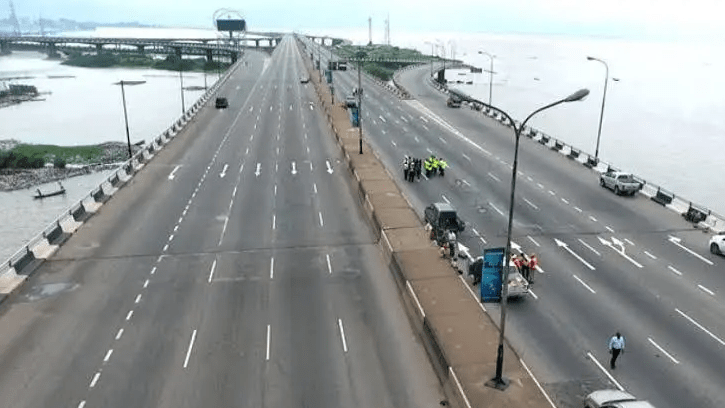
Carter Bridge To Be Demolished and Replaced: Condition Deemed Irredeemable
The famous Carter Bridge in Lagos may be demolished and replaced as its deteriorating condition has been declared as irredeemable by the Federal Government and other stakeholders.
has been Carter Bridge, since more than a century ago, has embodied Lagos history and served as a functioning artery connecting Lagos Island to the mainland. The bridge that most Lagosians are used to was initially constructed during the colonial era and reconstructed and refurbished numerous times afterward, transporting generations of merchants, commodities and people across the lagoon. But in recent weeks the federal government’s finding that Carter Bridge is “irredeemable” has crystallised long-held skepticism about its integrity, the futility of band-aid repairs and the tough decisions between heritage and public safety. The statement by the Ministry of Works follows a comprehensive inspection and appears to close the book: officials now inform us that the span is not savable and that the only viable options are reconstruction or replacement.
The history of Carter bridge goes back to the colonial Lagos days of the British.
The first Carter Bridge was constructed close to the start of the twentieth century and was named after Sir Gilbert Thomas Carter, Governor of the Lagos Colony in the 1890s. At its opening, the bridge was a major engineering achievement for the city; for many decades it was the only permanent road link between the island and the mainland, with trading flows and urban development being affected. The bridge was successively changed, enlarged, and in certain instances rebuilt to handle increasing traffic and improving standards of engineering with the passage of time. The most critical works were done in the mid-twentieth century and again in the 1970s when the Alaka-Ijora flyover and related work were carried out to handle increasing numbers of vehicles.

Despite repeated interference, however, Carter Bridge has long suffered the cumulative scourge of age, overuse and delayed maintenance. Congestion, regular parking of commercial transport on the span, and the corrosive sea environment have combined to accelerate decay.
Experts and commentators have frequently warned that cosmetic treatments and piecemeal re-surfacing cannot remove ingrained structural defects. The recent government inspection is said to have uncovered extensive damage to the underdeck and other load-carrying elements—discoveries that, officials insist, make rehabilitation impossible and economically imprudent alongside building a new crossing. The practical ramifications of declaring Carter Bridge irredeemable are close and far-reaching. For island-mainland commuters and businesses that depend on the Iddo–Idumota corridor, the threat of demolition and rebuilding means months, even years, of detours, congested substitute roads and higher logistics costs for traders who depend on efficient island-mainland transfers.
For urban planners and policymakers the issue is how to fit in the disruption while ensuring that any replacement is future-proof: constructed for current traffic volumes, resistant to the coastal erosion that hastened the deterioration of the old bridge, and part of cross-cutting mobility improvements so that a new bridge does not simply repeat past mistakes.
The economic stakes are enormous in the sense that Carter Bridge is not just infrastructure; it is supply chain that keeps ports, markets and Lagos’s informal economy buzzing.
Besides logistics, there is the issue of heritage and civic memory. Carter Bridge is part of Lagos’s landscape, commemorated in photographs and oral traditions that link current residents to a colonial history. Some preservationists will demand the preservation of elements of the original fabric—piers, plaques or interpretive markers—if a replacement is pursued.

But sentiment must not be prioritized over safety corning the Carter Bridge.
When structural assessment suggests failure is probable, the ethical imperative is to save lives and livelihood. Any redevelopment plan should therefore consider how best to pay tribute to the bridge’s history even as engineers remove or replace the non-salvageable elements.
Policy and governance lessons abound. The Carter Bridge crisis emphasizes the cost of delayed investment in infrastructure and the disadvantages of temporary repair. It demonstrates the need for regular, transparent structural inspections, distinct funding mechanisms for lifecycle maintenance, and procurement mechanisms that prioritize resilient materials and strong design for coastal bridges. In the short term, authorities must plan new traffic corridors, increase planning for a replacement bridge, and support—where feasible—those firms most vulnerable to harm in the longer term.
In the medium term, Lagos and the federal authorities must inscribe more rigorous maintenance regimes and project funding models so that other crucial links do not reach an irreversible state. Its removal as it has existed would be a loss of some sort, but substitution of an unsafe bridge is not a defeat; it is a sober acknowledgment that cities grow. Lagos now requires bold but cautious action: a replacement that learns from history, respects local history wherever possible, and is designed for the next hundred years of a fast-changing megacity. If that is achieved, the true lesson of Carter Bridge will be one of toughness—an urban commitment to vision, capital and functionality that ensures infrastructure serves people consistently and securely, rather than as a monument whose decay threatens them.