
Monthly Inflation Firms as Food Inflation Re-emerges
Monthly Inflation in Nigeria Firms up as Food Inflationary Pressure Re-emerges according to reports from the National Bureau of Statistics
Headline Inflation
Headline inflation decelerated noticeably in November 2025, easing to 14.45% y/y from 16.05% in October (–160bps). This marks the eighth consecutive month of disinflation, underscoring a sustained moderation in year-on-year price pressures, largely reflecting favourable base effects and the lagged impact of earlier monetary tightening.
In contrast, on a month-on-month basis, headline inflation ticked up to 1.22%, up from 0.93% in October (+29bps), extending the upward momentum observed in recent months. This m/m uptick was primarily driven by a sharp acceleration in food inflation, which more than offset the relative moderation in core inflation components. The rise in
food prices reflects seasonal supply dynamics, as the peak harvest period begins to wane, alongside heightened festive-season demand, which has intensified pressure on food distribution, transportation, and storage costs.

Food Inflation
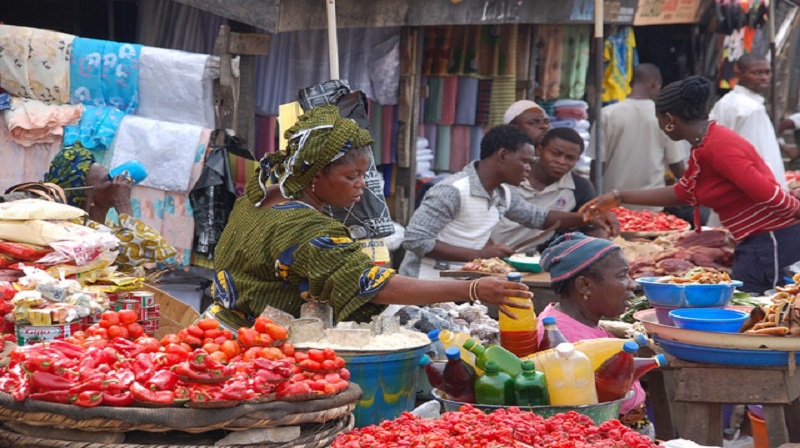
Food inflation eased by 203bps to 11.08% y/y in November from 13.12% in October, reflecting favourable base effects. However, on a month-on-month basis, food inflation rebounded to 1.13% from –0.37% (+149bps), as seasonal harvest gains began to wane and festive demand strengthened. The m/m increase was driven by higher prices of onions, dried tomatoes, cassava, periwinkle, pepper, eggs, crayfish, and egusi, among others. Imported food inflation also edged up to 0.60% m/m from 0.35%, supported by a 1.72% m/m depreciation of the Naira to
₦1,446.74/US$1, although exchange-rate pass-through remained relatively contained.
Core Inflation
Core inflation eased to 18.04% y/y in November (–65bps from October), reflecting favourable base effects. On a month-on-month basis, core inflation softened to 1.42%, down 13bps, indicating a modest deceleration in underlying price momentum.
The m/m deceleration reflects mixed price dynamics across core components. Upward pressure persisted in health (2.71% vs. 0.57%), transport (2.94% vs. 2.92%), restaurant and accommodation services (2.15% vs. 2.10%), services (1.78% vs. 1.52%), and recreation, sport and culture (1.58% vs. 0.80%), largely driven by higher logistics and service delivery costs.
These pressures were partially offset by slower price increases in furnishings and household maintenance (0.19% vs. 0.91%), clothing and footwear (0.10% vs. 0.38%), housing, water, electricity, gas and other fuels (1.24% vs. 2.86%), education (0.02% vs. 0.78%), ICT (0.12% vs. 0.54%), and insurance and financial services (0.18% vs. 1.71%). Overall, core inflation remains sticky, despite the y/y moderation, pointing to continued structural and cost-driven pressures.
Regional Inflation Dynamics
At the sub-national level, Rivers recorded the highest inflation rate on a year-on-year (17.78%), followed by Ogun (17.65%), Ekiti (16.77%), indicating stronger price pressures. Meanwhile, Plateau (9.13%), Kebbi (10.32%), and Katsina (10.60) recorded the lowest headline inflation rates. On a month-on-month basis, Bayelsa (6.58%), Gombe (5.11%), and Edo (4.45%) experienced the highest increases in inflation, while Plateau (-2.54%), Delta (-2.38%), and Kaduna (-2.24%) recorded the slowest increase. SOURCE: CORONATION ASSET MANAGEMENT LIMITED