November FGN Savings Bond offer is now open for subscription
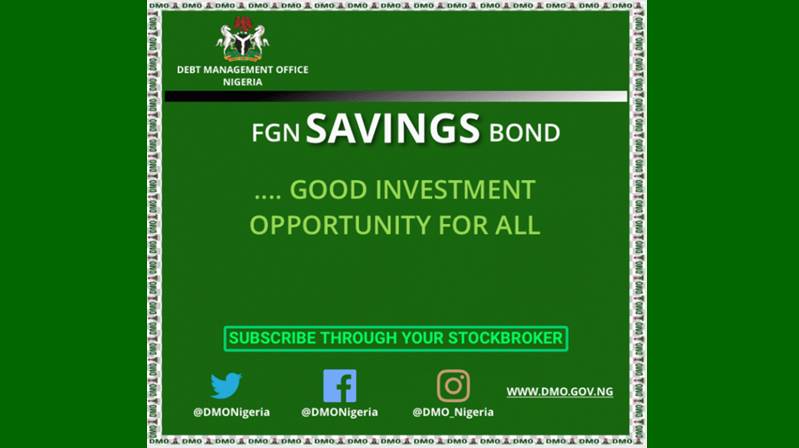
The DMO has opened the November 2025 FGN Savings Bond offer, which is a retail-focused, low-risk fixed-income instrument backed by the full faith and credit of the Federal Government. This guide explains what’s on offer, the key dates and economics, who can invest, how to subscribe step-by-step, tax and listing details, and practical tips to make a safe subscription. For the official offer document, see the Debt Management Office DMO’s offer PDF.
What’s being offered -tenors, rates, interest payments
The November 2025 offer consists of two tenors:
2-Year FGN Savings Bond — due 12 November 2027, coupon 13.565% per annum.
3-Year FGN Savings Bond — due 12 November 2028, coupon 14.565% per annum.
Interest will be payable quarterly on 12 February, 12 May, 12 August and 12 November, with principal being repaid in a single bullet payment at maturity. The settlement date for this issue is 12 November 2025.
Units, minimums and maximums
- The bonds are sold in units of ₦1,000. Minimum subscription and increment rules are investor-friendly:
- Minimum subscription: ₦5,000
- Multiples thereafter: ₦1,000
- Maximum subscription per investor: ₦50,000,000.
Why investors choose the FGN Savings Bond
The FGN Savings Bond targets retail savers for whom security with predictable cashflows is desired. Key highlights of the issue for investors include:
Backed by the Federal Government of Nigeria-so principal and interest are sovereign obligations.
Qualifies, under Nigerian tax statutes, as government securities for pension funds and other institutional investors.
Listed on the Nigerian Exchange, hence trading on the secondary market is possible after allotment.
Key dates (November 2025 offer)
- Opening date: 3 November 2025.
- Closing date: 7 November 2025.
- Settlement / Value date: 12 November 2025 (interest accrues from this date).
Who can subscribe
The FGN Savings Bond targets retail and institutional investors. It can be subscribed by individuals, trustees, pension funds, corporate entities, and retail investors, subject to the maximum limit. Applications are accepted by local stockbrokers, commercial banks, and nominated distribution agents on behalf of the DMO. Please check the official list of approved distribution agents on the DMO website.
How to subscribe — step-by-step
Determine the tenor and amount: select the 2-year or 3-year bond and determine how much to invest (minimum ₦5,000; multiples of ₦1,000).
Find an approved distribution agent: stockbroker/ PDMM/ participating bank. The DMO publishes a list of distribution agents — you can download the offer form from the DMO site or get one from your stockbroker, bank, or authorised agent.
Fill out the application form. Complete investor details with the amount and tenor. If you apply via a broker or bank, they’ll often take care of the form and the submission process.
Pay in full on application; usually, payments are required on submission – check the exact payment instruction with your distribution agent. The offer document will also confirm this; for example, it may state that allotment payments are payable in full on application.
Submit the form through the distribution agent before the closing date. Ensure to keep proof of payment and your acknowledgement slip.
Await allotment result. An allotment result is published by the DMO together with a corresponding allotment advice to successful applicants. An unsuccessful or partially allotted applicant receives refunds in line with the DMO’s timetable.
Settlement and coupon payments. If allotted, your bond position will settle on the settlement date and you will start receiving quarterly coupon payments. The bonds are listed on the Nigerian Exchange, so post-allotment secondary trading is possible.
Payment Methods and Practical Tips
Use traceable bank transfers or authorized payment channels recommended by your distribution agent. Avoid informal cash routes. Confirmation of beneficiary account details is necessary with the agent prior to transferring the funds.
If you’re using a stockbroker, they normally handle the whole submission, payment, and allotment tracking. If using a bank, speak to the treasury or retail desk that handles government securities.
Tax Treatment and Regulatory Notes
The offer document confirms qualifying status under relevant tax laws for pension funds and certain institutional investors. The bonds are recognised government securities under the Company Income Tax Act (CITA) and Personal Income Tax Act (PITA) for tax exemption status as applicable to pension funds and other qualifying investors. Always confirm your own tax situation with a tax advisor.
Secondary market and liquidity
The bonds shall be listed on NGX and, therefore, may be traded after allotment on the secondary market through licensed brokers. Liquidity may vary depending on the issue and prevailing market conditions; if you expect to need funds before maturity, check likely secondary market activity with your broker.
Safety and risk considerations
The FGN Savings Bond is a sovereign security; as such, it is one of the lowest-credit-risk Nigerian financial instruments. However, market (interest rate) and liquidity risks cannot be ignored. Interest-rate risk means that rising interest rates can lower the market price of outstanding bonds. Confirm that you submit applications only through DMO-authorised distribution agents. A list is available on www.dmo.gov.ng ) to avoid frauds.
Where to obtain official documents and further assistance
- DMO offer document official PDF: FGN Savings Bond Offer for Subscription — November 2025 (downloadable from the DMO site).
- DMO main page on FGN Bonds(Requirements & Distribution Agents) : https://www.dmo.gov.ng/fgn-bonds