Nigeria’s Inflation Slows Down: What You Need To know
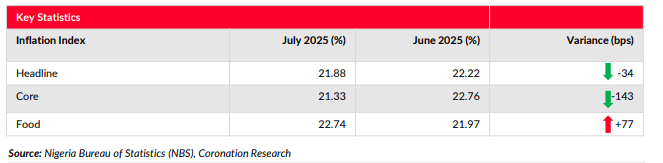
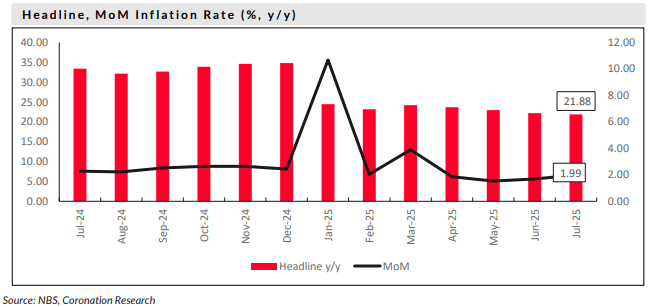
In accordance with our Nigeria’s Inflation projection’s direction, headline inflation decreased by 34 basis points to 21.88% year-on-year from 22.22% year-on-year in June 2025, marking the fourth consecutive month of disinflation, primarily due to favorable base effects. This suggests that inflationary pressures remain, albeit at a reduced rate. Meanwhile, on a month-on-month basis, headline inflation rose by 31 basis points to 1.99%, indicating higher price increases in July compared to the average price growth observed in June.
Core inflation has decreased following last month’s elevated levels. Core inflation fell to 21.33% year-on-year in July, down 143 basis points from 22.76% in June. On a monthly basis, the index slowed to 0.97% from 2.46%, reflecting widespread declines across various sectors: services (0.48% vs. 3.24%), transport (0.37% vs. 2.04%), housing (-1.15% vs. 0.73%), information & communication (1.99% vs. 2.72%), and insurance & financial services (1.26% vs. 1.54%).
Conversely, prices increased in healthcare (1.80% vs. 0.11%), clothing (0.80% vs. 0.24%), and restaurants (1.90% vs. 0.60%), but these increases were not sufficient to counterbalance the declines in other major components. The moderation was aided by a slight appreciation of the naira (1.34% month-on-month to an average of ₦1,531.35), which helped alleviate import cost pressures. Furthermore, reduced transport activity—likely a delayed effect of heightened energy costs in July following the escalation of tensions between Israel and Iran in June—further contributed to the slowdown.
Early harvest has alleviated month-on-month inflation. Food inflation rose by 77 basis points to 22.74% year-on-year from 21.97% in June. On a monthly basis, food inflation slightly decreased by 14 basis points to 3.12% month-on-month, down from 3.25% (the highest level this year) in June. This decline is largely supported by improved domestic supply, which has eased prices for vegetable oil, beans, local rice, maize, wheat flour, guinea corn, and millet whole grain, among others.
Regional Inflation Trend
In July 2025, Borno experienced the highest headline inflation rate at 31.63%, followed by Abuja at 26.79%, and Benue at 25.91%, indicating ongoing price pressures in these areas. Conversely, Zamfara had the lowest headline inflation at 9.90% year-on-year, with Yobe at 13.51% and Sokoto at 15.78%, suggesting a more moderate increase in prices.
On a month-on-month basis, the most significant inflation increases were observed in Ekiti at 5.39%, Delta at 5.15%, and Lagos at 5.13%, indicating short-term price pressures in the southern states. In contrast, Zamfara (-6.89%), Niger (-5.35%), and Plateau (-4.01%) recorded the largest month-on-month declines, contributing to a broader national slowdown.
MPC Poised to Sustain Restrictive Policy to Anchor Price Expectations
The real interest rate stands at 5.28% (MPR – Headline Inflation), remaining in positive territory since the beginning of the year, which has created an environment of positive real returns for investors, except for short-term government securities whose yields have recently fallen below the inflation rate. Nevertheless, the Monetary Policy Committee (MPC) has maintained a restrictive policy stance for three consecutive meetings, reflecting the ongoing upward trend in month-on-month inflation.
We believe the MPC is also keeping rates high to preserve the momentum gained from previous tightening cycles and to maintain the appeal of carry trade flows into the fixed-income market. Considering these factors, we expect the MPC to uphold its HOLD position at the forthcoming meeting in September. SOURCE: Coronation Asset Management