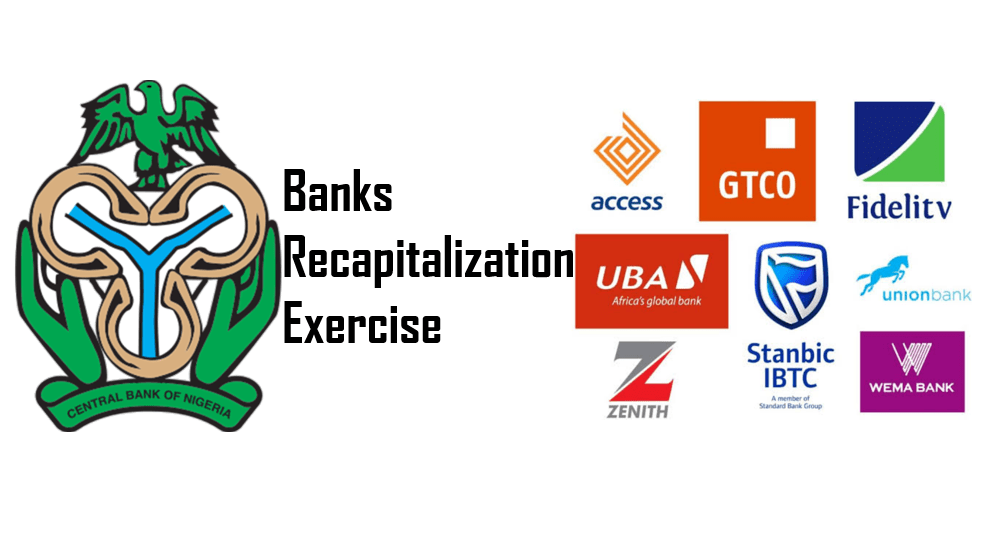
Bank Recapitalization Exercise Concludes as 33 Banks Raise ₦4.65 Trillion and Four under review
The Central Bank of Nigeria (CBN) has officially concluded its landmark Bank Recapitalization Exercise or Programme, announcing on April 1, 2026, that 33 out of approximately 37 affected banks have fully met the revised minimum capital requirements. In a two-year exercise that began with the March 28, 2024 circular, Nigerian banks collectively raised ₦4.65 trillion in fresh equity—72.55% from domestic investors and 27.45% from international markets—marking one of the most significant capital build-ups in the sector’s history.
The programme was designed to strengthen the banking industry against macroeconomic shocks, enhance lending capacity, and position Nigerian banks to support the Federal Government’s ambitious target of a $1 trillion economy by 2030. CBN Governor Olayemi Cardoso described the exercise as “orderly, non-disruptive, and confidence-enhancing,” noting that no depositor funds were lost, no forced mergers occurred outside approved frameworks, and banking services remained uninterrupted throughout the period.

New Minimum Capital Requirements: A Tiered Approach
Under the revised framework, the CBN raised the minimum paid-up capital thresholds as follows:
- International commercial banks (operating across Africa and beyond): ₦500 billion
- National commercial banks: ₦200 billion
- Regional commercial banks (limited to specific geopolitical zones): ₦50 billion
- Merchant banks: ₦50 billion
- Non-interest (Islamic) banks – national: ₦20 billion
- Non-interest (Islamic) banks – regional: ₦10 billion
These increases—more than double the previous requirements in most categories—were necessitated by inflation, naira devaluation, rising non-performing loans in certain segments, and the need for banks to absorb larger economic risks while expanding credit to key sectors such as manufacturing, agriculture, and SMEs.
Banks That Have Met the New Capital Requirements
While the CBN is yet to publish an exhaustive official list, provisional compliance data compiled from regulatory filings, bank announcements, and industry reports confirm that all major Tier-1 and Tier-2 institutions, along with most smaller players, have successfully complied. Below is a breakdown by licence category:
International Authorisation Banks (₦500 billion minimum) These “mega banks” now operate with significantly fortified balance sheets:
- Access Holdings Plc (Access Bank) – raised over ₦351 billion via rights issue; total capital exceeds ₦600 billion.
- Zenith Bank Plc – raised over ₦350 billion through rights issues and public offers; capital now ₦614 billion.
- First HoldCo Plc (FirstBank) – met threshold via rights issue, private placement, and divestment proceeds.
- Guaranty Trust Holding Company Plc (GTCO/GTBank) – multi-phase equity raise pushed subsidiary capital above ₦500 billion.
- United Bank for Africa Plc (UBA) – raised ₦178.3 billion in rights issue (plus earlier injections).
- Fidelity Bank Plc – private placement of ₦259 billion lifted capital to ₦564.5 billion.
- FCMB Group Plc – public offer and divestment proceeds secured compliance.
National Commercial Banks (₦200 billion minimum)
- Stanbic IBTC Holdings Plc
- Wema Bank Plc (raised ₦150 billion via rights issue)
- Ecobank Nigeria
- Sterling Financial Holdings Company Plc (Sterling Bank)
- PremiumTrust Bank
- Standard Chartered Bank Nigeria
- Globus Bank
- Optimus Bank
- Citibank Nigeria
- Providus Bank–Unity Bank consortium (CBN-approved business combination)

Regional Commercial Banks (₦50 billion minimum)
- Parallex Bank
- Signature Bank
- SunTrust Bank Nigeria
- Alpha Morgan Bank
- NOVA Bank
- Tatum Bank
Non-Interest (Islamic) Banks All four operating institutions met their respective thresholds (₦20 billion national / ₦10 billion regional): Jaiz Bank, Lotus Bank, TAJBank, and The Alternative Bank (under Sterling HoldCo).
Merchant Banks Several merchant banks, including FSDH Merchant Bank, Greenwich Merchant Bank, Rand Merchant Bank, and others, also achieved compliance within their ₦50 billion category.
Banks Yet to Complete the Exercise and Current Status
Four institutions did not fully meet the March 31, 2026 deadline and remain subject to ongoing regulatory and judicial processes. The CBN has assured the public that all banks remain fully operational, with no impact on depositor funds or day-to-day services. The non-compliant banks are:
- Union Bank of Nigeria – Under regulatory intervention; subject to court rulings and resolution processes. The CBN has reaffirmed oversight and stability in a separate April 2026 statement.
- Polaris Bank Limited – Still undergoing verification and restructuring under CBN supervision.
- Keystone Bank Limited – Part of ongoing intervention framework; discussions on strategic options (including potential recapitalisation or merger) continue.
- Unity Bank – Also under review.
The CBN has indicated it will soon release a comprehensive post-deadline compliance report, including a possible “soft window” for verification of late inflows and a clear roadmap for the intervention banks. No customer-facing disruptions are expected.
Broader Implications for the Economy and Banking Sector
The successful recapitalisation is expected to unlock greater lending capacity, reduce systemic risk, and improve the sector’s ability to finance large-scale infrastructure and industrial projects. Analysts project improved Capital Adequacy Ratios (CAR) well above the regulatory minimums (15% for international banks, 10% for others), providing a stronger buffer against future shocks.
For customers, the exercise reinforces confidence in the safety of deposits and the reliability of digital banking platforms. However, some analysts warn that smaller regional players may face pressure to merge or seek strategic investors in the coming quarters. Read our earlier analysis on how these changes intersect with the CBN’s new BVN regulations here.
Economically, the ₦4.65 trillion injection—largely from local pension funds, high-net-worth individuals, and diaspora investors—signals renewed faith in Nigeria’s financial system. It also aligns with the CBN’s broader reform agenda, including enhanced stress testing and risk-based supervision.
Looking Ahead
As Nigeria’s banks enter this new capitalised era, the focus shifts from raising funds to deploying them productively. The CBN has pledged continued oversight to ensure the fresh capital translates into real economic growth rather than mere balance-sheet padding.
The apex bank’s official press release on the conclusion of the programme is available on its website: CBN Concludes Banking Sector Recapitalisation Programme. For context on the original policy announcement, see the BBC Pidgin explainer: Wetin e mean for different pipo and di economy?.
The 2024–2026 recapitalisation exercise will be remembered as a pivotal moment that transformed Nigeria’s banking landscape from vulnerability to strength—without the turbulence that characterised previous rounds in 2004/2005 and 2009. With 33 institutions now better armed for the future, the sector is poised to play a leading role in Nigeria’s quest for sustainable, inclusive growth.